Roller pen plotter
Not build-ready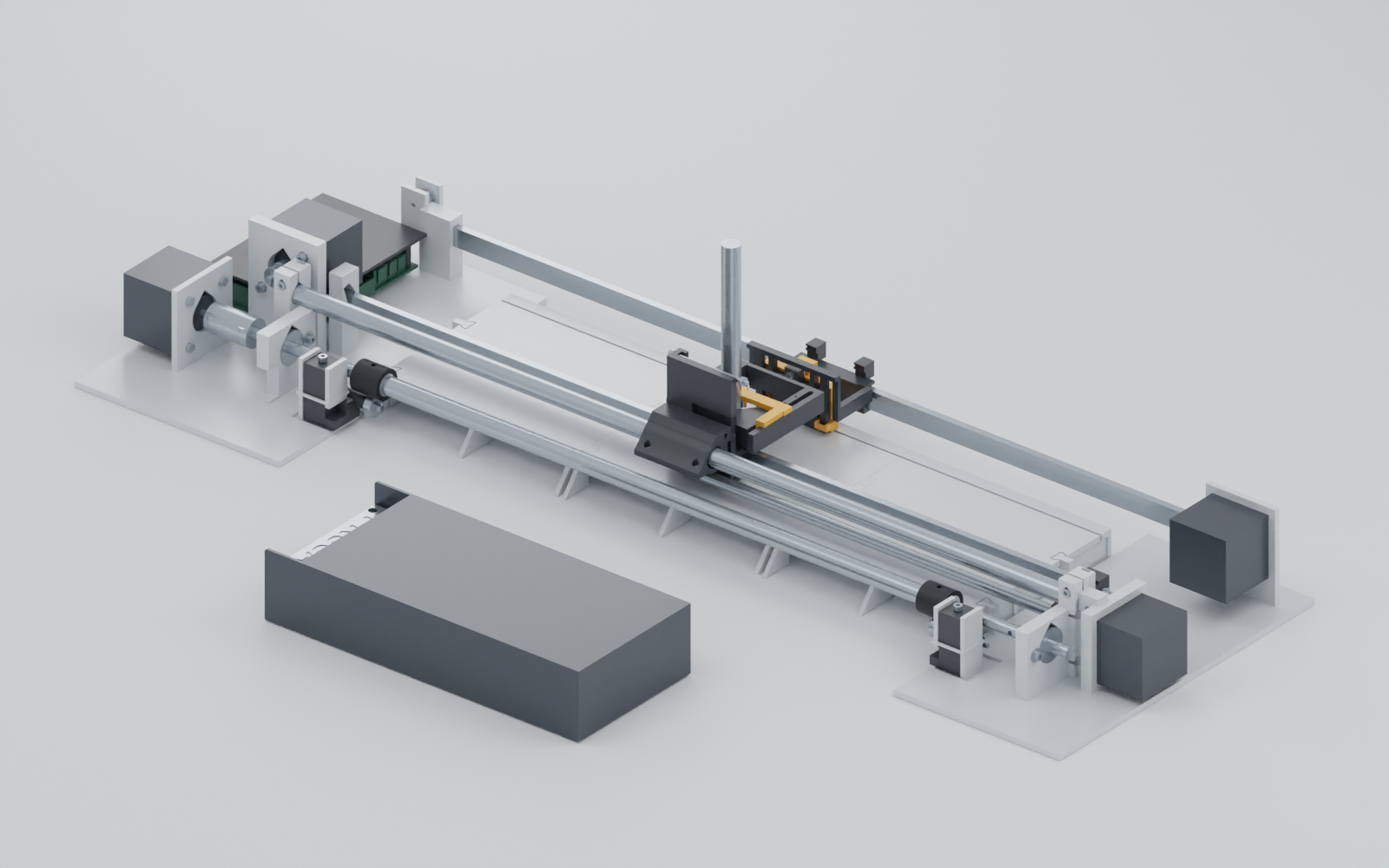
Analytical two-stroke test: 400 mm circle and 250 mm square. Unmatched catalog rollers reach 1.608 mm point error against a 0.5 mm target; 64 sampled matched builds stay below 0.283 mm under unmeasured assumptions. Physical precision is unverified. An image-comparison false alarm is fixed. Mismatch and slip failures remain.
Blade change: nominal CAD motion with all 16 cutter components and fasteners. Native extraction checks 16 source bodies, including the guide: 330 certified finite planar faces and two projected 4.99 mm² candidate gib surfaces; four of ten newly checked faces remain unresolved. The closeup marks two 0.9 mm shared edges. Seating is unverified. Forces and equilibrium remain unverified. Nominal contact closeup. Closeups and video show the prior guard with a 5.3 mm unsupported span. The belt keeper passes three native support probes; full coverage is unverified. The rear still has a cantilever warning. A separate guard revision reaches 1.26 mm: OFF passes, but normal/tree add 1802/3151 support segments. Its full coverage and three guard-access routes remain unresolved. Motor-driven cutting remains unverified.
Revised assembly: 18 printed parts; 49 counted items still lack CAD. The released ABS nut shoe’s complete slide-in path clears the holder body on the bench, with no nut installed. Four of six probes pass native slicer gates; all six holder print checks fail full coverage. Normal mode also adds supports.
An earlier pen-holder source was rejected and unbuilt after a 611.845 mm³ overlap between its V-wall and jaw. A new three-piece holder candidate has closed meshes and no unexpected overlaps in 21 nominal pair checks. View holder candidate (nominal pose, representative pen). ABS slicing finds the body and jaw have floating shells, and the jaw has a 7.6 mm bridge; only two of nine limited slice probes pass, and full coverage, motion and assembly remain unverified. A tapered jaw removes the detected bridge and floating shells in the supports-off probe; normal/tree still add 2,472/5,138 support segments. Nut retention with the new rear opening is unverified. The revised body reduces normal/tree support segments from 14,191/96,529 to 8,547/74,385; 326 floating segments remain.
A newer one-piece cradle with a proposed 12.7 mm strap reduces the holder to one printed part. In nominal CAD, 99 sampled round and rectangular pen bodies clear the cradle and touch both V faces. In the earlier layout, the 5 mm and 12 mm example pen bodies intersect the lift rail at the seated position. A revised cradle shifts the V forward 3.5 mm: 99 sampled pen bodies have no solid-volume collisions against 111 modeled objects along a 160 mm vertical path. All three ABS slice probes still flag 47 floating-shell segments at 25% infill; 100% infill raises that to 99, and four walls raise it to 258. Bambu marks these as overhang paths; the label alone does not prove a print failure (slicer source). The earlier 1.20 mm bridge estimate counts same-layer neighbors; a 27.40 mm stretch lacks directly underlying centerline coverage, although the bead edge overlaps. Same-layer anchoring is unverified. A flipped orientation produces a 27.43 mm unsupported bridge estimate and is rejected; physical printing remains unverified. A lighter cutout removes 11.10% of the cradle's CAD volume; the same 47 overhang paths remain and retention is unverified. A preliminary rigid partial strap intersects the cradle at 5 mm. Moving its exits forward 0.5 mm clears sampled strap shapes for 5, 12 and 35 mm pens against the available CAD. Actual strap closure and retention remain unverified. An idealized static check, assuming centered strap load and only strap/V contact, cannot balance the tipping moment for 5 and 12 mm pens at assumed friction coefficients of 0.2 or 0.4. Real contact and friction are unmeasured. Lowering the unmodified strap to the V height intersects the existing cradle at all three tested sizes. A wider window clears 121 sampled round partial straps but blocks 56 of 96 rectangular samples in static CAD. A broader window clears 217 modeled round and rectangular partial straps, but its thin supports have unverified strength and all three ABS slice gates fail. Printing on a V face also fails, with a 32.79 mm bridge proxy. A sloped window roof was rejected: 17 of 99 nominal pen samples lose upper-band contact, and generated supports increase. An illustrative 1 N static load gives about 0.014 mm force-weighted Y movement at the large-pen contact on the finest mesh. The two finest meshes differ by 7.9%; the model assumes a fixed rear face and solid isotropic ABS, omits opposing strap forces, and does not qualify the printed part. ABS specimen data. Compare the broader window (static CAD; new shape at left). Compare the windowed cradle (static CAD; new shape at left). Compare cradle shapes (static CAD; lighter candidate at left).
View revised cradle (representative pen and partial strap). Watch insertion (5 mm pen-body proxy and selected CAD; strap, nib, hands and forces are omitted). The 5 mm and 35 mm round pen bodies have centers 21.21 mm apart; tip registration is not implemented or measured. Compare registration (illustrative, unmeasured errors). Strap retention, loading and whole-machine operation remain unverified.
Whole-unit images remain earlier references. Belt fit, snap forces and motor-driven operation remain unresolved. The partial electronics-cover model passes full ABS 0.4/0.20 mm coverage checks in all three modes at resolvable scale. Its 89 sub-nozzle slivers, complete cover and other profiles remain unverified.
Earlier validation notes
Earlier-render notes: Current CAD trims the carriage around a nominal roll envelope: 13.4% less solid CAD volume; physical mass is unmeasured. Feed rollers and factory passages are dimension-derived reconstructions. An earlier experimental flat-pad clamp passes 3,957 nominal CAD checks and one supports-off ABS slice. That earlier body still fails with an 8.29 mm bridge and three surface gaps; total gap area is slightly worse despite fewer gaps. Automatic-support probes generate supports. Loaded retention, blade guarding, paper handling, cutting, ABS strength and whole-machine physics remain unverified. Complete-machine views remain the earlier source candidate; the clamp study is unadopted. New split-cutter images are unadopted. Nominal joint/tool clearance is checked; full loading and blade handling remain unverified. The gib passes all three support probes at 0.4/0.20 mm ABS. Current cutter printing still fails: the rear body has a 5.08 mm bridge, and front-guard support probes fail. Belt backing intersects both X anchors. The videos and 36-page PDF show an earlier reference assembly; build and operation are not verified.
27 October: Later component tests clear the revised belt anchors and guide assembly. The cutter's earlier finger-clearance clash is resolved in nominal CAD. Blade guarding and grip remain unverified. The pen cassette clears 1,646 nominal loading and floating checks; its permanent pedestal adds about 5.4 g of ABS, but is rejected after slicing found a 47.6 mm unsupported span. These revisions are not shown in the older whole-unit images. Support-free printing and motor-driven operation remain unverified.
Earlier reference symbols · 1–9
The numbered symbols in the earlier videos and PDF identify missing hardware or unqualified checks in that reference, not the current CAD inventory.
- Control board and mounting/insulation
- Driver channels, cooling and verified donor compatibility
- Power supply, inlet, switch, fuse and guarded mains/low-voltage separation
- Motor/power harnesses, connectors and strain relief
- Homing/limit/guard sensing and mounting
- Complete feed-to-rewind coupling, retention and brake/torque control
- Finite-caliper paper threading/reversal and near-empty traction evidence
- Qualified blade retention, guarded service and cut-force evidence
- Physical ABS fit, strength, creep and support-free contour/skin qualification
Keep the blade covered; disconnect power before blade changes. Do not drill the frame or substitute M5 pivot hardware.